Sunday, July 31, 2011

Turkmen Gas Finally Gets Washington’s Attention – A Little too Late

One of Washington’s key policy tenets since the 1991 collapse of Communism has been to pry out from under Moscow’s control as much of the energy assets of the post-Soviet space as possible.

Nowhere has this policy been more evident than in the Caspian basin and the energy riches of the new post-Soviet states of Azerbaijan, Kazakhstan and Turkmenistan. To the north lies Russia, with whom Washington jostles for these assets while Iran rings the Caspian’s southern shore, a rogue “axis of evil” member state that Washington has been punishing with sanctions on its energy sector since well before the Evil Empire collapsed.

Now, in a stunning example of naïve hope over geopolitical and economic reality Washington is wooing Turkmenistan, hoping to get a slice of the pie of the world’s fourth or fifth-largest natural gas deposits.

What caused the drooling in Beltwayistan was the release in May of a report by the respected British audit firm Gaffney, Cline and Associates on Turkmenistan’s gas reserves. The report concluded that the South Yolotan natural gas superfield, discovered in 2006, contains reserves of more than 20 trillion cubic meters of natural gas, enough to satisfy European demand for more than 50 years and making it the second largest gas field ever found. It should be noted here that when in 2006, following the field’s discovery, Turkmenistan’s megalomania cal ruler, Saparmurat “Turkmenbashi” Niyazov claimed that the discovery boosted the country’s reserves up to 24 trillion cubic meters of natural gas, his claims were taken as mere braggadocio, with BP calculating them at slightly more than 1/10th that amount. A similar thing happened two years later, when Gaffney, Cline and Associates first audited South Yolotan, and their findings were initially ridiculed as overstated.

Who’s laughing now?

Secretary of State Hillary Clinton’s special envoy on Eurasian Energy, Ambassador Richard L. Morningstar was hurriedly dispatched to Ashgabat, where on 14 June he met with Turkmen President Gurbangeldy Berdymukhammedov after which he gurgled, “The U.S. praises the energy policy of Turkmenistan and its positive initiatives relating to global energy security and the development of broad international cooperation.”

Perhaps Morningstar’s staffers forgot to remind him that early last year Turkmenistan inaugurated two new pipelines to China and Iran that have given Turkmenistan additional export routes for its gas. If the special envoy felt that he had maneuvering room with Berdymukhammedov, it was because the Turkmen ruler is reportedly still annoyed with Gazprom, which unilaterally drastically cut its imports of Turkmen gas on 9 April 2009, causing an explosion at the 302nd-mile segment of the Soviet-era Truboprovodnaiia sistema Sredniaia Aziia-Tsentr (the Central Asia-Center, or SATS, pipeline system) SATS-4 Davletbat-Daryalik pipeline between the Ilyaly and Deryalyk compressor stations near the Turkmen-Uzbek border, halting Turkmen natural gas exports to Russia, which had been running at 42-45 billion cubic meters (bcm) per annum. Gazprom only resumed imports in January 2010, but at a much reduced level. While the new Chinese and Iranian lines have picked up some slack, the Turkmen government still remains angry with Gazprom for the reduced revenue stream.

Even assuming that Morningstar’s diplomatic charms are sufficient to woo Berdymukhammedov to consider gas exports westwards, there remains the small issue of dividing the Caspian’s offshore wasters and seabed, a niggling legacy of the collapse of the USSR two decades ago. Briefly put, Russia favors a solution whereby the five Caspian states receive allotments proportional to their coastline, while Iran is holding out for an equitable 20 percent division for all.

Despite their diplomatic distance however, there is little doubt that both Russia and Iran would oppose the construction of any such undersea Caspian pipeline linking Turkmenistan and Azerbaijan, and the military and diplomatic pressure they could bring on their neighbors would and could be formidable.

Oh, and did I mention that on 30 June that China announced its second pipeline with Turkmenistan, a $22 billion, 5,370 mile pipeline with an annual capacity of 30 bcm had begun operations and that Beijing is on target to replace Russia as Turkmenistan’s leading export market within a few years?

It would seem that Morningstar landed in Ashgabat more than a few days late and a few rubles – err, yuan, short.

Article by John Daly, appearing courtesy OilPrice.com.


View the original article here

Sunday, July 17, 2011

Woman Business Owner Creates Clean Energy Jobs By Being Bold

Wendy Jameson’s life slogan is “Fear Mediocrity: don’t be afraid to be bold”; a motto that Wendy and her partner in Colnatec, Scott Grimshaw (whom she met on Twitter), established. Wendy has always been an individual who stands out from the crowd and takes risks each and every day, the epitome of an entrepreneur. She is a former business consultant and coach with 25 years experience in sales, marketing, and business strategy for growth companies. A wife and mother of two boys, family has always been an important part of Wendy’s life, too.  But they are not the only people she calls family–the nine employees who work for Colnatec care for each other and believe in the success of Colnatec as much as she does.


Colnatec is a woman-owned “greentech” company from Gilbert, AZ that designs and builds thin film process control sensors for nanotechnology manufacturing.  They have developed and patented groundbreaking film thickness measurement products for making solar cells, mobile displays, optics, and flexible lighting & electronics that increase production yields, decrease manufacturing costs, and improve efficiencies.


The holder of eight patents, they are recipients of a Department of Energy Phase I SBIR award for a revolutionary sensor to be used in manufacturing CIGS solar cells. This sensor will enable manufacturers to achieve cell and module efficiencies well beyond current capability.  Colnatec is also one of 8 winners of the Arizona Innovation Challenge grant program, which was established through $1.5M in ARRA funds provided to Arizona to promote innovation, specifically in the technology sector, and encourage export manufacturing. These funds have enabled Colnatec to hire 3 people in 2011, purchase production machinery, finalize product development, and market globally.


The funding we’ve received has been like a shot in the arm—a significant morale boost,” said Wendy. “It’s proof our science is sound, but even more importantly, that others believe in us too. It gave us not only confidence, but also hope that we really could achieve our dreams.”


Article by Anne Filipic, Deputy Director of the Office of Public Engagement


View the original article here

Saturday, July 16, 2011

Winergy’s HYBRIDDRIVE Gearbox and Generator Combo


Winergy is a German company long known for its quality and innovation in gearboxes and drive systems for wind turbines.

At the American Wind Energy Association (AWEA) Windpower Conference and Expo last month, Winergy introduced its new 3 MW HYBRIDDRIVE technology, which combines a 2-stage gearbox and a permanent magnet generator into one product (Winergy press release).

According to Winergy’s press release, the new design provides the advantages of reduced size and weight of the nacelle and drive train:

The direct linkage of the two stage gearbox and the permanent-magnet driven generator shortens the drive train by approximately 35%. This design allows for a significant reduction of the nacelle size and minimization of the overall weight.

Winergy found the inspiration for its new gearbox and generator combo from work performed by Global Energy Concepts LLC (GEC) in a DOE funded study for the WindPACT program back in 2000 – 2002.

The GEC drivetrain utilized a 2-stage gearbox with a CARB bearing which allows the second stage to free float to maintain alignment between the gear mesh of the first and second stages of helical gears. This has the benefit of being able to absorb most deflections and off axis loading conditions encountered by the stochastic nature of the wind.

Although it also utilizes a 2-stage gearbox, instead of a CARB bearing, the Winergy HYBRIDDRIVE has a different internal bearing arrangement. Winergy’s web site doesn’t provide details, but one of the company’s representatives at the AWEA Conference indicated that they have a double row tapered roller bearing arrangement and bushings with elastomeric dampers as well as a torque tube to accommodate loading and deflections.

Two-stage gearboxes are not new for Winergy. The company also owns U.S. Patent No. 6,459,165 (’165 Patent), which is entitled “Drive train for a windmill” and relates to drive train architecture that utilizes a double row helical set of gearing. It is possible that this prior IP has contributed to the design of the HYBRIDDRIVE system.

The ’165 Patent is directed to a transmission arrangement for a wind turbine including a rotor (1) with several blades (3) secured in a hub (2). The rotor (1) is connected to a generator (6) via a two-stage planetary transmission comprising an input stage (4) and an output stage (5).

The hub (2) is directly connected to the base (10) of the input stage (4) of the two-stage planetary transmission, which is entirely contained in the hub (2). According to the ’165 Patent, this arrangement provides a more compact transmission suitable for higher outputs:

The object of the present invention is a wind-power plant that is more compact and accordingly appropriate for higher outputs, of 2.5-5 MW, is only slightly heavier, and is less complicated. Directly connecting the hub to the input stage of the two-stage planetary transmission renders the transmission more compact.

Winergy also owns U.S. Patent Application Publication No. 2010/0160104 (’104 Application), entitled “Epicyclic gearbox for a wind power installation” and directed to a forced lubrication system on a two stage drivetrain.

Lubrication is an obvious necessity of rotating machinery, but a forced lubrication system saves the cost of a separate external system with pumps and other associated components, and it can also improve overall drivetrain efficiency. The ’104 Application discusses one way in which a forced lubrication system can be made to work for a two stage gearbox with independent channels for each stage

It remains to be seen if the new Winergy design will prove to be as good as the free floating CARB bearing design in terms of reliability and the ability to absorb loads. Winergy advertised the HYBRIDDRIVE at 25 tons, which is very light if that metric actually includes the generator weight. However, it was unclear from the self-contained drivetrain on display at the Expo whether the generator was integrated in what was shown.

One caveat to a lighter weight gearbox is that they need to be able to prevent deflections of the gearbox housing, which can lead to significant reliability issues. Scrimping on housing mass to save weight might contribute to deflection problems and misalignments of their gears.

We’ll have to wait and see if this is a long term issue. If the 25 tons is just the gearbox without the generator, then this isn’t terribly light at all and the extra mass there may serve to inhibit some of those deflections.

The deflection issues are also prevalent because wind turbine OEMs are chasing higher capacity factor ratings with the increased rotor diameters, and the loads on the drivetrain and tower are increasing as a result. The proof will be in the pudding for Winergy as they test and deploy this solution for Fuhrländer AG for their new 3MW, 120m rotor turbine for IEC Class IIa.

With the reliability of the direct drive systems yet to be proven, it’s great to see innovation on gearbox driven designs which take advantage of 30+ years of development and testing to enable more reliable solutions. After all, as Winergy says, “Reliability is our profession.”

Article by Eric Lane and Philip Totaro.

Eric Lane is a patent attorney at Luce, Forward, Hamilton & Scripps in San Diego and the author of Green Patent Blog. Mr. Lane can be reached at elane@luce.com.

Totaro & Associates is an innovation strategy and patent search consulting firm. To find out more please visit www.totaro-associates.com.


View the original article here

Friday, July 15, 2011

WHY WE ARE STILL USING FOSSIL FUELS?

The amount of energy in fossil fuels is enormous simplamente. A gallon of gasoline weighs only 6 pounds and contains about 35 kWh of energy, what an automobile would spend half an hour of road approximately. A normal person who continually pedalling a bicycle would take about a thousand hours to produce this amount of energy, and could also bet that he would lose more than six pounds in the process. Coal, diesel, oil and natural gas are able to produce amazing amounts of energy.

The hidden treasure of the energy in fossil fuels has allowed our society develops at unprecedented speeds. It has also altered the environment most of the first consumers had been able to imagine.


Today, our challenge is to the left of search for energy beneath the Earth and start searching power of the Sun, wind and rain.

Thursday, July 14, 2011

Transport of the future "LINT"


The new commitment in the public trasnport seems technology departure from Hollywood himself. To be able to imagine it just need to see the movie of Tom Cruise, "minority report".


The project, promoted by a group of companies and Mexican educational institutions, is called LINT (Lean Intelligent Network Transportation), is a system of automated urban transport which is actually based on a concept emerged in the Decade of the 70'sknown as the PRT (Personal Rapid Transit) and that it could bring part of the solution to problems of mobility that afflicts many of the great cities of the world.


The concept is light vehicles for two, four or six persons which would be borne by a system of roads, underground or elevated, prefabricated and easy to assemble, allowing thanks to its technology, maintaining a constant flow of transport.


Vehicles, which will handle automatically, could be reserved by phone or Internet, so that when a person comes to the station at a certain time, the unit already what this waiting.


The project, which is a year of research, although it is designed for cities, might work in its initial phase in places such as airports or amusement parks.


The technological gamble which could be a reality from 2016.

Wednesday, July 13, 2011

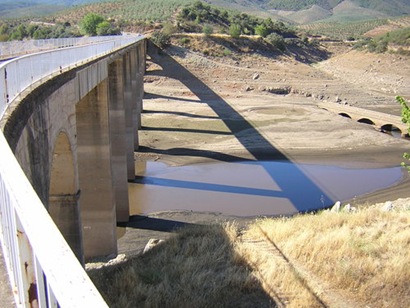
Spain Rios decrease flow


Among the main consequences of climate change, not only we find noticeable increase or change in temperature, but other consequences, which may or not detach from it, with the loss of biodiversity , or what compete us on this occasion, the decrease in the flow of the rivers, result not only increased evaporation , but a disturbance in the water cycle.


As it has been announced recently, within the framework of the Conference "river conservation: threats, challenges and opportunities for a sustainable future" organized by the Fundación bbva, have given to the different conditions that have rivers and Spanish river basins, and his apparent loss of flow, with data rather than alarming.

The decrease is estimated at an average of 10%, caused not only by climate change, but by the establishment of dams, canals, reservoirs and other modifications that have not been adapted to a suitable water plan .

Has been highlighted in addition Spain is one of the countries of the world with a greater number of dams per km of river, of which at least 1,200 are superior to 15 metres in height, assuming a major threat to fluvial species, to help improve the quality of the waters.


At the Conference also been attention to compliance with the legislation, which estimate has very little control because of a decrease in the funds budgeted for it, which leads to jeopardize not only the biodiversity of a river, but also the supply of drinking water.

The proposal is not only the application of technology, coupled with investment for their development, but also a correct solution that does not interfere with the natural river channel, which leads to the current decline in the flow.

The basin of the Mediterranean Sea has not remained alien to these factors, which was joined a marked overexploitation of resources, where there has been a high point in the Segura basin, where the percentage of the water consumed by envelope available resources has come to 224%, where the rivers remain dry in several months of the year.

Added to this in addition the appearance of the so-called Emerging pollutants, which do not have a specific control and tend to escape from the sewage treatment plants, affecting the ecosystem of the River, mostly being used both human and veterinary drugs .

Monday, July 11, 2011

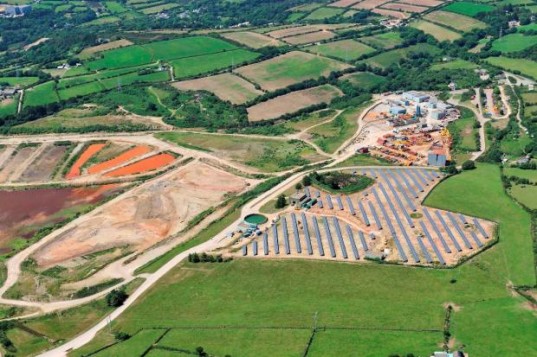
Deserted UK Tin Mine Transformed into 1.4MW Solar Power Plant


An out of use tin mine in the south west of England is on its way to becoming a hotspot for renewable energy. Earlier today, more than 5,600 solar panels on the site were fired up by Solarcentury and UK-based solar developer Lightsource Renewable Energy. The new 1.4MW solar power plant will generate enough electricity to power more than 400 homes, and it is just one of many green energy developments planned for the site. The ultimate goal is to turn the abandoned mine, located at the historic Wheal Jane site in Cornwall, into the UK’s first earth science park to use renewable energy from solar, wind, hyd


The new power plant covers a 7.2 acre plot of land, and it is one of the largest solar farms in the UK. Solarcentury designed and constructed the entire plant in less than two months, and local workers were employed to prepare the site and construct the building. Plans for the entire 60,000 sq. ft. site’s transformation into a sustainable business park are currently underway. (You can find details about all of the site’s renewable energy projects here.)

“To see a tin mine diversify into producing 21st century clean solar energy, provides an optimistic glimpse of where we’re now heading for our energy production,” said Derry Newman, CEO of Solarcentury. “Wheal Jane’s solar farm demonstrates that solar technology can contribute to our clean energy future, and quickly.”

Several other large solar arrays are underway and will be connected to the grid by the end of the month. A review by the UK government put a stop to funding for solar projects, making it unlikely that many more large scale plants will be started any time soon. This means that the solar plants being built this summer will play a critical role in the UK’s green energy production.

+ Solarcentury

+ Wheal Jane Sustainability Project

Via Treehugger


View the original article here