Showing posts with label panels. Show all posts

Tuesday, October 2, 2012

SoloPower Offers Relatively Expensive Panels with a Potentially Huge Cost Benefit


Editor’s Update October 2, 2012: Someone has notified me that SoloPower has not actually posted anything on the cost of SoloPower’s solar modules, and that the numbers below (which we retrieved from Greentech Media) are extrapolated from another technology. I am contacting SoloPower to try to get confirmation of that.

We wrote about SoloPower in March when it broke the efficiency record for CIGS solar modules, and we’ve actually covered the company a few times over the past few years. SoloPower charges $2.20 per watt for their flexible solar panels, if purchasing a whopping 10 MW (10,000 kW) of panels, that is. On such a large-scale, typical hard solar panels made of metal and glass (or plastic) can cost $1 per watt.

SoloPower’s flexible CIGS (Copper Indium Gallium Selenium) solar panels have some clear installation benefits. They can be pasted onto roofs without penetrating them. Penetration requires expensive contractors, and the construction of mounting equipment for solar panels does, too.


SoloPower’s flexible CIGS solar panels.
Flexible solar panels can also be installed onto uneven surfaces much more easily than typical rigid metal panels, and they can even be installed onto surfaces that it would be impossible to mount rigid metal panels onto.

As you can see in the picture above, installation can actually be very simple, and this opens up a window of opportunity to install solar panels yourself, which is far cheaper than having a contractor install them. This is because solar panel installation is so expensive that it costs more than the panels themselves.
There is a catch to flexible thin-film solar panels, though. They tend to be less efficient than rigid mono-crystalline panels, and they are more expensive.

The easy pasting installation concept also has a catch. Pasting panels on your roof may entail replacing your roof when the panels go bad, depending on the type of roof you have.

If you have an asphalt roof, then the panels could outlast the roof, but they normally have the same lifespan as the roof (20 years). So, ideally, the panels are likely to need replacement at the same time as the roof.
There are also adhesives which can easily be peeled back off — although I can’t verify how long such adhesives could last. And there’s one major catch to this idea — ease of theft. Solar panels that are permanently glued to roofs cannot be stolen, so their theft deterrence is superior.

For smaller scale projects that are up to 500 kW, SoloPower’s panels cost $2.95 per watt.
SoloPower is headquartered in San Jose, California.
Source: Green Tech Media

Photo Credit: SoloPower
Interested in free solar estimates for your home?


View the original article here

Tuesday, September 18, 2012

The Best Solar Panels


Solar energy has become one of the most important renewable energies, and indeed we ourselves can not only count on it in cars or appliances that work with this energy, but we can also have it at home with solar panels that can install ourselves and which will allow us to take full advantage in the light of the Sun and thus not having to use electrical energyso it is necessary to know what the best or most suitable for our needs.
There are two types of solar panels and are panels photovoltaic traditional, that may be best known, and the of thin-film panels.The difference between the two, or indeed what everyone knows about them is that the photovoltaic can be installed in the soil or studs or ceiling and also its size is quite considerable.For the layer thin, which are in fact also solar, there is to say that they are much more fine, installed with some ease on a ceiling or on a terrace, for example and so many people are much more aesthetic, to put it in some way, most beautiful.


Photovoltaic solar panels, and surely you have seen at the top of buildings or large fields, are able to pick up their energy from sunlight and thanks to the use of a silicon and other materials that allow you to store this energy.

They are very good when the Sun is shining, in other words, they provide lots of energy but not so when the sun sets, by what they say with a storage system that allows that we have energy accumulated, similar to what do the batteries.Aside from a clear difference between its thickness, or the way in which they are installed, it must be said that the solar panels are photovoltaic or layer fine, are in both cases quite expensive in your installation (of layer a little more thin), and although probably not reach us the budget, we have to bear in mind that in the long run it will be a investment for the future
 May we now spend a lot of money in a few panels on our terrace install us, but think of all the money in the long run and over the years, you'll be saving in electric power conventional.


This type of solar panels also "suck" the energy of the Sun, although for many people they are still best, because they are simply much more fine, and in fact are able to bring us a lot of energy.These panels that are of a very thin film, are made from a material that is very light and flexible.

A material that allows very thin layers and is reactive to what does prevent the need for thick layers of other panels.So it is that, I repeat, are better for many people, but them can put on the floor or tiles of a terrace or a roof and without any support whatsoever.


Friday, September 14, 2012

Economic and Affordable Solar Panels

Technology, increasingly take their efforts in achieving technologies less pollutants and the possibility of generating solar energy that has a price accessible to the consumer.

This has been the case of a company in United States has announced a recent product that fill the expectations of all who seek to save electricity and solar alternative energy costs.

The company is First Solar Inc, and they say that it is making a type of solar panel that will cost 1.00 dollar per watt (Watt), and in addition, is anticipated get better yields and possible improvements to what the cost is for the future.

It should be clarified that currently the approximate cost of manufacturing what 3.00 dollars per watt (Watt), comparing it with this new technology, it is much more economical and accessible to the majority of those interested in using these alternative energy sources.

According to First Solar Inc., this is just a beginning and already new technologies are emerging to achieve best ways to save environmentally.


View the original article here

Sunday, July 15, 2012

Indias solar panels get a green signal

Many companies can start off with their work of developing the solar panels in a big way, as there would neither be interference nor intervention, as the solar panel constructions are now exempted from the environmental licensing.

Land clearances for construction of large solar-thermal power plants, will not be an issue of the past any longer. Some of the major Indian companies - Reliance Power Ltd. (RPWR) and Lanco Infratech Ltd. (LANCI) are now free to construct the solar-thermal power plants, as there are no more environmental-permit scrutinies.

India?s investment in solar projects will assure economic growth, as the conventional forms of energy- fossil fuels, firewood will be replaced by the renewable forms, ensuing the protection of the conventional energy forms for a longer duration. Besides, the government is also putting in consistent efforts to empower the rural areas by means of supplying cost-effective solar energy to generate electricity.

Solar energy is one of the most incredible sources of energy, used on a large scale to power various resources. Solar furnaces, water heating, solar cells are some of the prime solar generated working models. Construction of solar panels requires extensive area, about (309 acres) of land. Photovoltaic plants make use of solar panels that absorb the energy from the sun and directly supply power; thermal stations draw in sunlight to heat liquids that produce steam for generators.

Considering the exemption from environmental licensing, solar panel projects will now see a rise, resulting in growth of renewable energy.

Friday, February 17, 2012

Solar Panels Creating Electricity for Much Longer than 20 Years


As indicated in a study Josh wrote on just a couple weeks ago, the lifespan of a solar power system is far longer than the 20 years most analysts use to calculate solar power costs. Last November, Susan featured one that was going strong at 30 years.

A Facebook fan notes that solar panels at the Technical University of Berlin have been in operation for 31 years. Similarly, Kyocera, one of the oldest solar panel manufacturers in the world, recently posted on the fact that a number of its early installations continue to generate electricity reliably nearly 30 years after installation.

kyocera solar panels have long lifespan

I would also note that technology has improved, solar panels have become more durable, and if early solar panels produce electricity for far more than 20 (or even 25) years, what to expect of today’s solar panels?!

Here are a few case studies Kyocera highlighted in its recent article on the matter:

In 1984, Sweden’s first grid-connected photovoltaic system was built in Stockholm. Since its installation, the façade-mounted 2.1kW system has been continuously and reliably providing the residents of an apartment building with environmentally-friendly electricity. The modules’ average annual power generation performance is still reliable — with no significant change since the system was installed 27 years ago.

Also in 1984, Kyocera established its Sakura Solar Energy Center just outside of Tokyo. At the time, the Center was equipped with a 43kW solar power generating system which to this day continues to generate a stable amount of power for the facility.

In 1985, Kyocera made a donation of a 10kW solar power generation system to a small farming village with no electrical infrastructure located at an elevation of 2,600m (8,500ft) in Gansu Province, China. In 1993, the area received electrical infrastructure, and the solar modules were moved to a regional research facility for clean energy, where after more than 25 years, they are still producing consistent levels of electricity.


View the original article here

Tuesday, January 24, 2012

Stunning Origami Solarcell Lamps Are Made From Folded Photovoltaic Panels!


Korea-born, Eindhoven-based Joon & Jung‘s Origami Solarcell is a polygonal low-energy LED lamp that is completely powered by the sun’s energy. The pendant lights are made from a flexible photovoltaic material that is folded into a 3D lamp using origami techniques.


The flat-pack multi-faceted lights are still in the prototype stage, but we hope to see these innovative, energy-efficient designs hit store shelves in the near future.


View the original article here

Sunday, November 20, 2011

Biosolar: Solar panels with ecological materials


The solar energy is one of the most important renewable energy sources in the world. And solar panels are one of the most effective applications of solar energy. A new development makes it possible that these solar panels can be built with ecological materials, and so obtain a doubly positive for the environment..


Solar panels are essentially devices that trap solar energy and turn it into direct current of electricity. The work of solar panels is based entirely on the photovoltaic effect, hence the called photovoltaic panels.


This brief introduction is to explain the photovoltaic effect required to occur in elements semiconductors. Semiconductor materials mainly used are single-crystal silicon and polycrystalline silicon, which is found in each of the solar cells and are covered by glass or other materials to waterproof.


All these layers comprising solar panels are placed on a substrate or bottom layer usually contains materials such as polyester or Tedlar (a type of thermoplastic).

Solar panels can become a "greener" device, when they are made with organic materials. This is the proposal of the new BioSolar Backsheet Solar Panels.

These solar panels have a substrate (backsheet) are not built with chemical based products?in materials such as polyester and Tedlar, the most common currently. Instead this lower layer of the panel is made with a material completely ecological, obtained from castor seeds.


In addition to its ecological advantage, new panels of BioSolar substrate material shows a better thermal performance than conventional materials. The operating temperature is lower, which is also one of the highlights of this type of solar panels.


In general, this type of solar panels provides a better performance in terms of mechanical strength, electromagnetic properties, durability of long-term and adaptability to the climatic conditions. Apart from that, recycling of solar panels proposed by the manufacturer also makes this solar panel advanced and according to the demand of the contemporary world.


The almost any dependency BioSolar Backsheet solar panels towards the products of petroleum makes it - not only more suitable for environmental security – but also more economical. Given that oil prices are increasing day by day, the greater stability of the value of its raw material and a lower cost of production also are points in favour.


One of the criticisms which this type ofecological solar panelsis that it requires a specific and precise monitoring in order to provide an optimum temperature of work during the process of generation of energy solar.


More articles featured on solar energy:


Solar energy could have its future in the colder regions of the planet


High efficiency solar cells


Solar cells with efficiency of 45 %


A Virus improves the efficiency of solar cells


Solar cells cheaper and more efficient with low-quality Silicon


Solar Cell film fine record of 28.2% efficiency


View the original article here

Wednesday, October 5, 2011

Solar panels


Solar panels are devices designed to capture part of the solar radiation and turn it into solar energy so that it can be used by man.


Two types of solar panelscan be distinguished:

Solar thermal panels: called thermal solar collectors, convert light into heat. There are two types of solar thermal: air and water collectors.

The collectors of water, water circulates the tubes fitted with fins. For best performance, the set is placed in a box of insulating glass as a greenhouse effect is achieved with this. With good Sun, and if the hot water needs are moderated, a simple network may be sufficient.

The fins, forming what is called the absorbent, are heated by solar radiation and transmits its heat to water that flows through the tubes. The water collectors are used for heating and/or to produce sanitary hot water.

Air collectors, is the air that circulates and is heated in contact with the absorbent. The air so hot is then vented heating environments or used in the sheds for drying of agricultural products.

Photovoltaic solar panels: called photovoltaic modules, convert light into electricity.In both cases, panels are generally flat, with several meters of width and length.

They are designed to facilitate installation and its price is fixed so that they can be used both for domestic and industrial applications.Solar panels are, at present, more economically viable than the photovoltaic modules. Solar panels are the building blocks of most of the production of solar energy equipment.

Interest in the use of solar panels emerges quickly when you know that a photovoltaic generator 329 km. could cover all of the

Tuesday, May 3, 2011

Solar Tracker Solar Panels

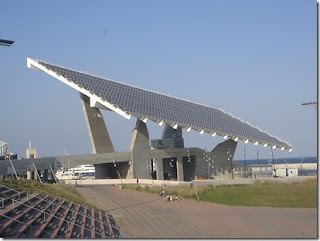
Solar Tracker A German owned company IMO has set-up a plant in USA that will make the largest solar tracker solar panels to tap solar energy. As per Ruediger Unverzagt and Klaus Pless, respectively the CEO and vice-president of this company, these solar tracker solar panels are the largest in Summerville in South California. IMO is looking forward to commercially sell these solar tracker solar panels. Despite being huge in size, they are very easy to assemble and one can assemble them just outside the building where they are to be installed.


How the solar tracker solar panels technology will help
IMO is hopeful that USA will embrace this source of energy because with its help, you can avoid the emission of carbon dioxide by 87,000 pounds that pollutes the air on an early basis due to burning of 34,000 pounds of coal. With the solar tracker solar panels, IMO will not need 42,000 kilowatts of power, equal to the power need by almost four households on an annual basis. It also saves the environment by the same extent as it would if 6,700 more trees are planted or the pollution is reduced by the extent caused by a vehicle traveling 106000 miles.


How the solar tracker solar panels technology works
The oversized solar panel is resting on a rotating pole. This solar panel is not stationary but keeps on moving with the sun. This way panel catches maximum solar rays from the sun. Stationary solar panels remain fixed to a single spot. They catch whatever sunlight comes to their direction. But rotating solar panels following the sun’s daytime path can capture 20 or 30% more solar energy. They keep on shifting their stand to capture more and more sunlight. You can compare them with sunflowers: sunflowers change their position with the position of the sun.


Size of the solar tracker solar panels
The large solar tracker solar panel that faces the sun and captures energy from its powerful rays is 1,614-square-foot metallic structures and is 53-foot-tall. Due to huge size, this big panel is put on top of the metal column with the help of crane. The manager of renewable energy program with the SC Energy Office, Erika Myres finds the size of this panel on the pole very surprising. As she keeps the track of individual panel projects around the state, she says that panels by IMO are the largest solar trackers in South California and each one is bigger than her first house.


Commercial use of the solar tracker solar panels
Though IMO will start the sale of these solar tracker solar panels very soon, similar alternative-energy devices have been sold by the executives of the company at its overseas headquarters. Whereas these executives are not ready to tell how much the figures of the sales are, their business has not reached great heights till now. The machine that can be used for 25 years cost between $100,000 and $200,000 .


The $150,000 grant provided to the company under the state’s Clean Green Energy Incentive Program has got exhausted. Now IMO is hoping that other companies and home owners could take the benefit of existing state and tax credits and finance their project.


View the original article here

Friday, March 4, 2011

Build Solar Panels - Declare Independence and Build Solar Panels

Home Made Energy

Say goodbye to electric bills and hello to renewable energies. Build solar panels. Solar power is one of the best and most reliable renewable energy sources available.

The problem most novice environmental warriors find is that the cost of professionally installed solar power systems is way beyond their budget and it could take well over 10 years to see a return on their investment.


Never fear, there are alternatives. The most cost-effective way to take advantage of the power of the sun is to make solar panels on your own.


Sound like too much? If you are scared it would be difficult, it is just not true. It is easy to construct solar panels with the proper instructions.


Easy enough for kids, teens and adults. The parts aren?t complicated either.

Most of the supplies you would need to make solar panels are available at your local hardware store or you can purchase a solar panel kit, which will include all the parts you require to be generating your own energy from the sun.

It is possible to construct several small solar panels to power small appliances or small tools in your workshop. Or for the very adventurous and determined alternative energy seeker, you could construct solar panels to service a much larger electric load.

Home made Solar Panel There are many resources and guides available with detailed instructions on how to build solar panels.

The first and most important step is to seek out quality detailed instructions. Then it is off to your local hardware store to find or order your supplies and next thing you know, or the next time you have some free time, you will be able to assemble and install the system yourself.


Watch out though, the neighbors may start asking you to construct solar panels for them too. Not only is it going to save you money to make solar panels yourself, but you can feel proud that you are doing your part for the environment as well.


Declaring your independence from fossil fuels and making a much-needed impact on the world and in your neighborhood.


Professional solar power systems can cost thousands to be installed and in today?s economy most of us don?t have money to spare. Make the choice to go solar today. and learn to build solar panels on your own. It will be savings you can be proud of.


How to Build a Solar Panel


View the original article here

Thursday, March 3, 2011

Walmart to Install Thin Film Solar Panels

Walmart Solar Prominent corporations are paying special attention to go green and create a conducive environment for clean and green energy. Walmart too is taking appreciative steps in the field of alternative energy. In the year 2007, Walmart entered into a partnership with Environmental Defense Fund (EDF) to provide a thrust to the photovoltaic technologies. It was related with thin-film solar. They aimed for taking it out from labs to the real world.

In the practical world, products should be commercially viable, consistent, and cost effective. Walmart is already installing the solar panels in its stores in southern California, Hawaii and Puerto Rico. Now they made it public to install more solar panels to another 20 to 30 outlets in California and Arizona. With this step they are moving towards their pledge of going 100% green in future.

Walmart will procure its thin-film solar panels from Tempe, Arizona-based First Solar and MiaSolé. First Solar utilizes cadmium telluride and MiaSolé, and makes use of copper, indium, gallium and selenide (CIGS) for their modules. Both of these companies offer low cost solar panels and provide an alternative to costly silicon based panels.

Why California and Arizona: California and Arizona were chosen for the new Walmart solar installations because of the simple fact that these two states receive ample sunshine. But another economic fact is that these two states provide financial incentives thus giving necessary impetus for the expansion of solar drive. Walmart also aims to portray itself as an organization that cares about the world its customers live in. It is not merely the price that attracts consumers towards brands and organizations it is also the way they conduct business and show sensitivity towards burning issues like the environment and natural disasters. So aside from cost savings and upfront incentives Walmart also feels enthusiastic about the environmental impact its new decisions are going to make.

Advantages of Thin-Film semiconductors:
First advantage is that these films are less costly than silicon based solar panels. Another plus point is since these films are just 1 micron thick they require less materials for manufacturing. They offer one more good advantage: since these panels are light in weight they can be easily mounted on flat rooftops and work deftly during accumulation of snow too. Thin-film panels don’t interfere with skylights. They also work better in smog or fog conditions. In advanced applications, thin film solar can even be incorporated into the building envelope itself, further reducing life-cycle cost.

Project’s Success: Alternative energy project’s successes are calculated by two mainly yardsticks. First, some significant amount of energy is converted into clean and green energy and second, how much greenhouse gas emissions are reduced. Thin-Film solar cells’ performance is not disappoint on these two fronts. They cost around the same or slightly less than the electricity generated from the conventional sources. Installing thin-film solar cells also give returns like any other infrastructure project.

Future Performance of Thin-Film solar Cells for Walmart:
After the installation of the thin-film solar cells in the proposed locations of Walmart they are expected to yield more than 22.5 million kilowatt hours of energy per year. This will meet up the 20 to 30% needs of the each outlets. If we want to know in terms of reduction in greenhouse gases, it would be equal to more than 11,650 metric tons of GHG. It means we are taking more than 3,000 cars off the road each year.

Kim Saylors Laster, who is the Walmart vice president of energy, says, “By leveraging our global scale to become a more efficient company, we are able to lower our expenses and help develop markets for new technologies. Developing and incorporating new renewable energy sources, like thin film, reduces energy price risk and aligns very well with our commitment to solving business challenges through technology.”

Looking at the 8,350 outlets of Wallmart, their going green move is still in infancy. They have a long way to go.

Interested in writing news articles about alternative energy? Contact Us


View the original article here

Friday, January 28, 2011

Its Easy to Learn How to Make Solar Panels

Home Made Energy

Learn How to make solar panels

Plenty of people have been looking into installing solar panels in an effort to combat rising energy costs.


When most of these people see the prices of the professionally installed panels they realize it may not be a luxury they can afford.


There is an easier, more cost efficient way to harness power from the sun and that is to learn how to build solar panels yourself.


Any motivated do-it-yourselfer can learn how to build solar panels for their home, workshop or business.


When compared to the cost of purchasing and installing a pre-made solar energy system, learning how to produce solar panels for your energy needs and the materials you need to execute the project are far less.


By learning how to build solar panels for yourself, you have greater control over the size and design of your system as well.

make solar panels

Once you have a quality manual and you have learned how to build solar panels, the supplies are fairly simple to find.

Most can be found at your local hardware store like, plywood, sheets of glass, and a roll of copper wire. It is also easy to locate inexpensive solar or photovoltaic cells to use in your project.


Many are available over the Internet or you may have a retailer available locally.


One you?ve learned how to build solar panels and you have your supplies, it usually takes about a day to assemble a 100-watt panel. This is the perfect amount of electricity to operate small appliances or a small workshop. The most important step is finding a quality manual with detailed instructions for learning how to build solar panels.


In many cases you get what you pay for, so don?t be afraid to spend a few extra dollars on a well-reviewed instruction manual.


Overall, the cost of the making your own panels is so low, the price of the how to guide is minimal-you will still be paying way less learning how to make solar panels on your own than purchasing a professionally installed system.


With a little bit effort, you can be on your way to learning how to make solar panels to meet your energy needs. Then sit back and bask in the pride the next time the power goes out on your block. Your lights will still be on because you learned how to build solar panels and your energy supply is still in your battery bank.


View the original article here

Tuesday, January 4, 2011

Solar panels economic and accessible

Technology, increasingly, cascaded their efforts on achieving cleaner and in the possibility of generating solar energy that has an affordable consumer technologies. This has been the case of a company in United States has announced a recent product will fill the expectations of all them looking for electricity and alternative solar energy cost savings.

Company is first Solar Inc., and say is to manufacture a type of solar panel that however cost of 1.00 dollar per watt (W), and also is provides for achieving improved yields and possible improvements by the cost refers to the future.

There are currently clarifying the approximate cost of manufacture is 3.00 UFO per watt (W), comparing it with this new technology, is much more economical and accessible to the majority of those interested in using these alternative energy sources.

First Solar Inc., this is just a start and technologies are already brewing to achieve better ways to save environmentally.

Sources-globbos.com, ecoticias.com, energy-think.net

· Solar energy First Solar Inc.